 Skip to main content

Villa Renovation Timeline Step by Step: Full Guide 2026
- July 24, 2026
- Zia Luxury
- 10:36 am
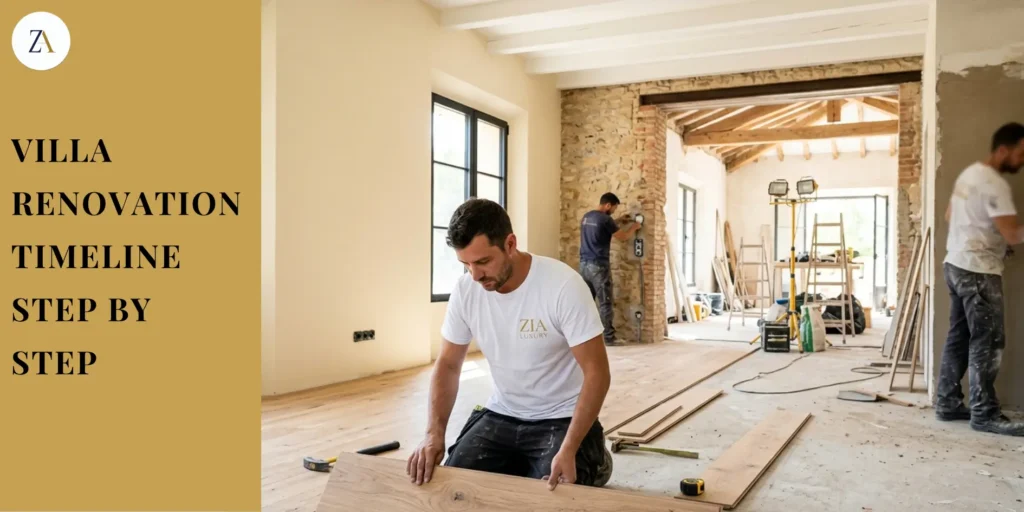
While renovating a villa in Dubai can be thrilling, it can also become quite a lengthy process without a definite schedule. The villa renovation has a lot of moving parts compared to what most homeowners realize when they venture into the project. There are multiple reasons why a Dubai Villa renovation is more complicated than most homeowners think, ranging from the Dubai Municipality permits, DEWA approvals, and community rules to the materials import lead time.
From design consultation to completion, this guide will demystify the actual timeline of a Dubai villa renovation, helping you to get a clear sense of each stage and what to expect along the way, while also preventing you from falling into the common pitfalls that many homeowners encounter when remodeling their villas.
Why Villa Renovation Timelines in Dubai Are Different
Dubai villa renovations encompass a combination of regulatory approvals, community needs, and international sourcing of materials, which are not typically encountered in other markets. Often, before Dubai Municipality reviews a permit, your community or HOA needs to sign off on a villa in Palm Jumeirah, Emirates Hills or Arabian Ranches. Include DEWA clearance for electrical and plumbing work, plus shipping lead times for imported finishes, and you can understand why a “quick renovation” can easily get away from you.
The key to keeping your project on schedule is having a realistic, phase-based timeline, and it’s the one most important factor between a renovation that comes to a successful end within the project timeline and one that drags on for months in month seven.
Phase 1: Planning & Design (Weeks 1–3)
The first step in any villa renovation is to meet with you in person to learn about your vision, budget, and your must-haves and nice-to-haves. Here, the scope of work is broken down room by room.
During this phase, your renovation partner should provide:
- A detailed site assessment and measurement survey
- 3D visual renderings so you can see the space before anything is built
- A fixed, itemized quote with no hidden costs
- A signed contract with binding timelines
Skipping a proper design phase is the single biggest cause of scope creep later on, so it’s worth taking the full 2–3 weeks here rather than rushing to demolition.
Phase 2: Permits & Approvals (Weeks 3–6)
This is the step most homeowners underestimate, and it’s also where competitor guides tend to go quiet on specifics. In Dubai, villa renovation permits typically involve three separate approval layers:
- Community or HOA approval — required for gated communities like Emirates Hills, Arabian Ranches, and Palm Jumeirah before any structural work begins
- Dubai Municipality building permit — needed for structural changes, extensions, or alterations to the villa’s footprint
- DEWA NOC (No Objection Certificate) — any change of electrical load, new AC units or significant plumbing rerouting requires a DEWA NOC.
These approvals can proceed simultaneously with the design process, but usually take 3-4 weeks total, and gated communities that have more stringent architectural requirements can take longer. But if you begin this process as early as possible, before you lock down all of your design details, then your overall timeline will be realistic.
Phase 3: Material Selection & Procurement (Weeks 4-8)
Once your design is approved, materials need to be selected and ordered. Typically, this is a concurrent phase to the permit phase to help to save time.
Lead times vary significantly by item:
- Imported tiles and marble — 4–6 weeks depending on origin
- Custom cabinetry and joinery — 5–7 weeks
- Sanitaryware and fittings — 3–5 weeks
- Bespoke furniture and lighting—6–10 weeks
A common mistake is finalizing material choices after demolition starts. Ordering long-lead items during the permit stage, rather than waiting for construction to begin, is one of the easiest ways to protect your timeline.
Phase 4: Demolition & Structural Work (Weeks 6–10)
With permits in hand and materials on order, demolition and structural work can begin. This includes removing existing finishes, opening up walls where approved, and preparing the foundation for any structural adjustments.
Key considerations during this phase:
- Load-bearing wall changes require engineer’s sign-off before removal
- Dust and debris protection should be set up for untouched areas of the villa
- Structural inspections may be required before moving to the next phase
For most villas, demolition and structural prep take 3–4 weeks, though larger extensions or full structural overhauls can extend this window.
Phase 5: MEP Works — Plumbing, Electrical & AC (Weeks 8–14)
Mechanical, electrical, and plumbing (MEP) work happens once the structural shell is ready. This is one of the most technical phases of any Dubai villa renovation, since it has to comply with both DEWA regulations and UAE fire safety codes.
This stage typically includes:
- Rerouting or upgrading electrical wiring and panels
- Plumbing repositioning for new bathroom or kitchen layouts
- AC ducting and unit installation or upgrades
- Fire and safety system compliance checks
MEP work is installed behind walls and ceilings, and this is the time when hidden problems, such as obsolete wiring or aging pipes, often come to light. Some flexibility around this will allow for any surprises without impacting the schedule.
Phase 6: Finishing & Fit-Out (Weeks 12–18)
This is where the villa starts to visually come together. Finishing works are usually the longest single phase because of the craftsmanship involved.
This phase covers:
- Flooring, wall finishes, and painting
- Custom cabinetry and joinery installation
- Kitchen and bathroom fit-out
- Lighting, fixtures, and hardware installation
- Landscaping or pool work, if included in scope
Finishing quality is where most of the renovation budget and time get spent, and it’s also where the difference between a rushed job and a well-executed one becomes most visible.
Phase 7: Snagging, Quality Check & Handover (Weeks 18–20)
Before handover, a full inspection should catch any defects—uneven tiling, paint touch-ups, faulty fittings—so they’re fixed before you move back in, not after.
A proper handover process includes:
- A full walkthrough with a defects (snagging) list
- Rectification of all identified issues at no extra cost
- Final documentation and warranty information
- A 12-month defects liability period, covering any defects that arise after move-in, preferably 12 months.
Full Villa Renovation Timeline: Quick Summary
- Medium-scale renovation (bathroom, kitchen, cosmetic work): 12–15 weeks
- A mid-scale renovation—such as multiple rooms and a few structural adjustments—can take a bit longer: 12-16 weeks
- Full Villa Renovation (Structural Change, Full MEP Overhaul, Landscaping): 16 – 20 weeks
These ranges assume permits and material orders move without major delays. Complex structural changes or premium imported finishes can extend timelines further.
What Can Delay Your Villa Renovation Timeline in Dubai
- Community or HOA approval is taking longer than expected in gated villa communities
- Late material selection is pushing back procurement lead times
- Discovering hidden structural or wiring issues once demolition starts
- Scope creep—adding new requests mid-project without adjusting the schedule
- Choosing a contractor without a binding, written timeline in the contract
Why Work With a Licensed Renovation Company in Dubai
Villa renovation involves structural changes, electrical systems, and community rules—where unlicensed or informal contractors pose actual risk on both financial and legal grounds.
Zia Luxury is a DED-registered and Dubai Municipality-licensed interior fit-out and renovation firm fully insured and bonded, that has worked on over 500 projects since 2019 across Dubai, including Palm Jumeirah, Emirates Hills, Dubai Hills, Arabian Ranches and many more. A quoted price is quoted item by item, and the time frame is negotiated with the client before work starts. A 12-month defects liability period is guaranteed after handover.
Frequently Asked Question
Most villa renovations take between 8 and 20 weeks, depending on the scope. Small cosmetic updates fall on the shorter end, while full structural renovations take longer.
Yes, structural changes or alterations to the villa's footprint require Dubai Municipality permits. Community or HOA approval may also be needed in gated developments.
Late material selection and slow permit or community approvals are the two biggest causes of delay. Starting procurement and approvals early helps avoid this.
It depends on the scope—cosmetic updates may allow you to stay, but structural or full-villa renovations usually require moving out temporarily. Your contractor should advise this during the planning phase.
A defects liability period covers any issues that surface after handover, such as paint touch-ups or fitting adjustments, at no extra cost. Zia Luxury includes a 12-month defects liability period on all renovation projects.
Conclusion
A well-thought-out villa renovation timeline is the key to a hassle-free transformation versus a stressful, extended undertaking. Before you start any villa Dubai renovation with Zia Luxury, we are happy to provide you with a no-obligation consultation so we can assess what you want, the budget you are looking at, and what is feasible for your renovation time frame.
Call Zia Luxury today to get your villa renovation started with a clear and binding timeline to follow!
