

False Ceiling Design in Dubai | Zia Luxury Interiors Guide
- August 22, 2026
- Zia Luxury
- 6:24 am
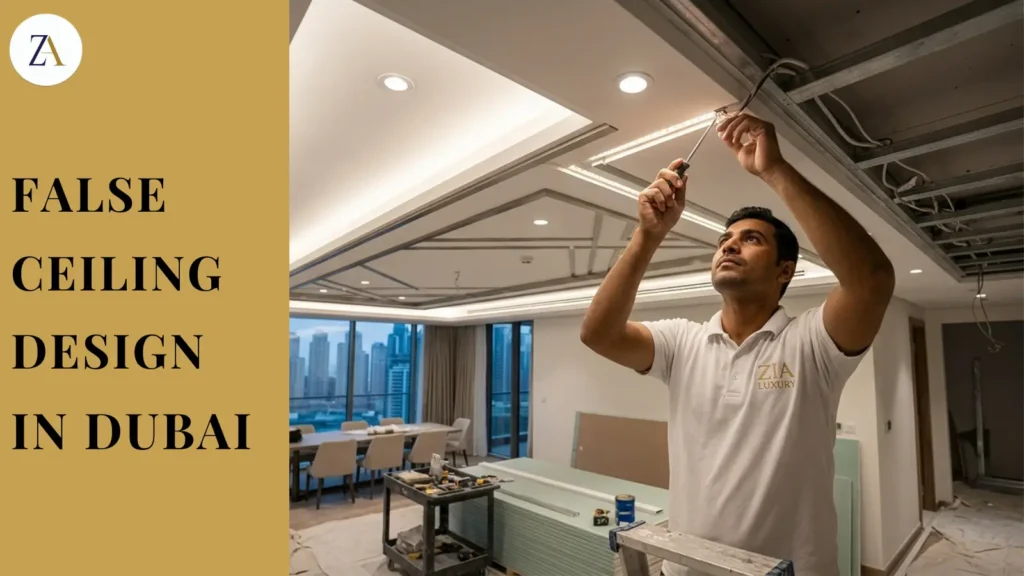
Walk into any well-designed Dubai home and look up—chances are, you won’t see a plain, flat ceiling. You’ll see layers, hidden lighting, clean geometric lines, or a soft cove glow running along the edges. That’s false ceiling design at work, and in Dubai it’s no longer a luxury add-on. It’s become one of the most requested elements in villa renovations, apartment fit-outs, and office interiors across the city.
At Zia Luxury, we’ve designed and installed false ceilings across 500+ projects since 2019, from Palm Jumeirah villas to Business Bay apartments. This guide breaks down everything you need to know before starting your own project — styles, materials, room-specific ideas, real costs, and the approvals nobody talks about.
What a False Ceiling Actually Does for a Dubai Home
Technically, it’s a second ceiling hung a short distance below your original concrete slab, usually built from gypsum, POP, PVC, wood, or metal. That gap between the two layers isn’t wasted space—it’s where all your AC ducting, wiring, and plumbing lines disappear from view.
But in Dubai’s climate, that gap does more than just hide mess. It works as a buffer against heat, easing some of the load your AC carries through the brutal summer months. It also gives you room to actually design with light—coves, layers, recessed fixtures—things a flat ceiling just can’t offer.
So really, the question most people should be asking isn’t whether they need one. It’s which design and material combination actually fits their room and their budget.
The Styles Dubai Homeowners Are Actually Choosing Right Now
Design tastes here have moved. The heavy, ornate patterns that were everywhere a few years back have given way to cleaner, more architectural shapes. A few styles keep coming up in client briefs:
- Cove ceilings: a recessed channel running around the room’s edge, hiding LED strips that throw a soft ambient glow rather than direct light
- Tray ceilings: a stepped design that adds real depth to a room, especially popular in majlis and dining spaces
- Floating or island ceilings: a suspended center panel, usually built around a chandelier or statement pendant light
- Geometric patterns: angular, segmented cuts that suit modern living rooms and home offices
- Backlit gypsum panels: panels with light built right into them, often placed behind a TV unit or feature wall
- Minimalist flush ceilings: no steps, no drama, just a clean single-level finish for people who want understated over showy
Most homes we work on mix two or three of these across different rooms rather than committing to one look for the whole property—and honestly, that’s usually the better call.
Room-by-Room False Ceiling Design Ideas
Living room
Higher ceilings here give you room to play with tray or floating designs. Pairing a central light fixture with perimeter cove lighting usually gives the best mix of everyday brightness and evening ambiance.
Bedroom
Cove ceilings with warm, dimmable lighting are what most clients end up choosing. If you’d rather the room feel quiet and restful, a simple flush design works just as well without the extra detailing.
Kitchen
This is a practical space first. Recessed downlights set into gypsum board give you the task lighting you need over counters and islands. It’s worth paying slightly more for moisture-resistant gypsum here—kitchens see more humidity than you’d think.
Majlis and dining areas
This is where people tend to spend the most on design, and it shows. Tray ceilings, chandeliers, and backlit panels—this is the room built for hosting, so it usually gets the most attention.
Home office
Skip the decorative detail. What matters here is glare-free, cool-white lighting that helps you focus, not a ceiling that competes for attention.
Material Comparison: Which False Ceiling Material Suits Your Space?
Material | Cost Range (AED/sq.ft) | Durability in Dubai Climate | Best Used For |
Gypsum board | 15–35 | Excellent — fire-resistant, stable in AC-cooled interiors | Living rooms, bedrooms, offices — most versatile option |
POP (Plaster of Paris) | 20–45 | Good, but less moisture-resistant than gypsum | Decorative ceilings, majlis, dining areas with intricate detailing |
PVC | 10–25 | Very good — moisture and humidity resistant | Kitchens, bathrooms, balconies |
Wood/wood-finish panels | 40–90 | Moderate — needs sealing against humidity | Feature ceilings, accent areas, warm-toned interiors |
Metal panels | 35–80 | Excellent — low maintenance, corrosion-resistant | Offices, commercial spaces, modern minimalist homes |
Gypsum remains the most commonly chosen material across Dubai homes because it balances cost, fire safety, and design flexibility better than the alternatives.
What False Ceilings Actually Cost in Dubai
Pricing comes down to four things: material, how complex the design is, the size of the area, and how much lighting gets built in. As a rough guide:
- A simple flush gypsum ceiling runs about AED 15–25 per sq.ft
- Cove or tray designs with LED lighting land around AED 30–55 per sq.ft
- Multi-level or backlit designer ceiling costs AED 50-90+ per sq.ft.
- Metal or high-quality wood-finish feature ceilings range from AED 60 – 100+ per sq.ft.
To give you an idea, most cove lights in high-mid-range designs in living rooms in the region of 300-400 sq.ft. will cost you anywhere between AED 10,000 – 20,000 depending on your lighting plan and layout. Regardless, always get a detailed and specific estimate before the job begins, and not an approximation that changes once the work is in progress.
The Approval Step People Forget About
This one catches a lot of homeowners off guard. Depending on where you live and what kind of property you have, false ceiling work can actually require sign-off before anyone touches your ceiling:
- Villas and townhouses in developer-managed communities—Emaar, Nakheel, Meraas, and similar—often need a developer NOC before any internal renovation, ceiling changes included
- Apartments may need approval from building management or the owners’ association, especially if the work involves rerouting electrical circuits
- Any time new lighting points or circuits get added, DEWA coordination comes into play
Skip this and you risk delays, or worse, a dispute right before handover. We handle the paperwork and approvals as part of the project scope, so it’s one less thing clients have to chase down themselves.
Picking the Right Design for Your Space
A few honest questions usually get you to the right answer faster than browsing endless design photos:
- How tall is your ceiling? Anything under about 2.8m suits flush or single-step designs better—multi-level trays can make a low ceiling feel cramped rather than dramatic
- What does the room actually need to do? Kitchens and offices need functional lighting first, aesthetics second. Living rooms and majlis can lean the other way
- What’s your real budget? Gypsum with LED cove lighting tends to give the best return for the money in most homes
- Will you want to change the lighting later? A more modular design with accessible wiring makes future updates far less of a hassle
Why Homeowners Choose Zia Luxury for False Ceiling Design
Zia Luxury has completed 500+ interior fit-out and renovation projects across Dubai since 2019, holding a 4.9 Google rating from clients across Palm Jumeirah, Emirates Hills, JBR, Business Bay, and Downtown Dubai. Every false ceiling project includes:
- Full 3D visuals before any work begins, so you see the design before it’s built
- Fixed, itemized pricing with zero hidden costs
- A dedicated project manager throughout the project
- Dubai Municipality-licensed, DED-registered execution
- 12-month defects liability period after handover
Whether you’re renovating a single room or an entire villa, our team manages design, approvals, and installation as one seamless process.
Frequently Asked Question
Most single rooms take 3–7 days depending on the design. A full villa with multiple rooms usually needs 2–3 weeks just for the ceiling work.
Gypsum generally performs better in AC-cooled interiors thanks to its fire resistance and stability. POP is better suited to detailed decorative work in lower-moisture rooms.
Yes — the air gap between your slab and the false ceiling acts as insulation, which can meaningfully ease your cooling load during peak summer.
Often, yes—particularly in developer-managed communities or wherever new electrical circuits are involved. We manage this documentation as part of the project.
A standard cove ceiling with LED lighting usually runs AED 4,000–9,000, depending on room size and how detailed the design is.
Conclusion
A false ceiling isn’t just filling space overhead—it changes how a room actually feels, hides the practical mess of wiring and ducting, and takes some pressure off your AC in a city where that matters. What’s right for you really comes down to your room, your budget, and how much design detail you actually want living above you every day.
If you’re thinking about a false ceiling project anywhere in Dubai, Zia Luxury offers a free consultation with 3D visuals and fixed, itemized pricing before anything begins. Get in touch to get started.
One Response