

In House vs Subcontracted Fit Out: Which One Costs Less?
- August 17, 2026
- Zia Luxury
- 6:40 am
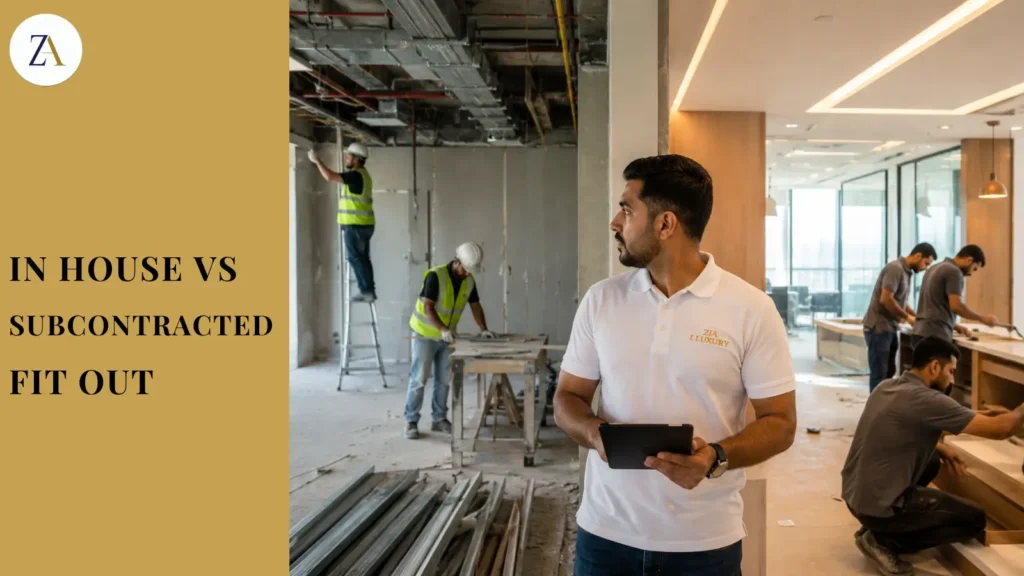
One choice that you will be making when you are going for a fit-out in Dubai, whether it is a villa fit-out, an apartment fit-out or a fit-out for a commercial space, might have the biggest impact on your budget, your timeline, and your peace of mind, and that choice is whether you hire a fit out company with an in-house team or a company that subcontracts the work out.
It may seem like a minor point in a proposal. It isn’t. This poor decision can not only affect your finances, but your warranty, your timeline, and months of menial work looking for answers that no one will provide. This guide explains each model simply, its real cost and which model is suitable for your project.
In-House Fit-Out: One Team, One Promise
An in-house fit-out means every trade—joinery, flooring, MEP, painting, ceilings—is executed by employees of the same company, under one project manager, on one contract.
Why it matters:
- Single point of accountability—no finger-pointing between trades
- One quality standard applied across the entire project
- Faster issue resolution because everyone reports to the same site lead
- Warranty sits with one company, not a chain of subcontractors
This is the model used by established Dubai fit-out companies with their own joinery workshops and permanent trade teams — the kind of setup where 300+ completed fitouts and a 98% on-time delivery rate aren’t just marketing lines but a byproduct of controlling every stage of execution internally.
Subcontracted Fit-Out: More Hands, More Questions
A subcontracted fit-out is where the company you hire is a project coordinator and the actual tiling, electrical, joinery etc is contracted out to another company (which is not on that company’s payroll).
What this looks like in practice:
- The main contractor takes care of the paperwork and client relationship.
- Specialist crews are hired on a project basis, rather than having a permanent job.
- Not all subcontractors have the same quality, even if they are in the same project.
- Warranty claims often bounce between the main contractor and the sub who did the actual work
Subcontracting isn’t automatically a red flag—highly specialized work (certain MEP systems, glasswork, or niche finishes) is sometimes better handled by a specialist sub even within an otherwise in-house model. The real risk is when every trade is subcontracted and nobody internally owns the outcome.
The Real Difference: What Nobody Tells You Before You Sign
Factor | In-House Fit-Out | Subcontracted Fit-Out |
Quality control | One employer standard across all trades | Varies crew to crew |
Timeline risk | Managed internally, sequenced by one PM | Exposed to sub crew availability clashes |
Communication | Single project manager, one line of contact | Often multiple parties, slower answers |
Warranty | Usually clear — one company, one contract | Can fragment across subs |
Cost transparency | Fixed, itemised quote upfront | Can look cheaper initially, variations add up |
Permit handling | Coordinated in-house alongside execution | May be outsourced or delayed |
Flexibility for niche work | Slightly limited to core trades | Easier to bring in rare specialists |
Final price vs quoted price | Rarely moves once contract is fixed | Higher risk of “surprise” variation costs |
Why the "Cheaper" Quote Often Costs More in the End
The typical range for Dubai fit-out prices is from AED 350/sqft for basic commercial fit out projects up to AED 1200+/sqft for ultra-luxury residential projects, and a fit out project for a solid mid-level luxury villa or apartment will fall somewhere between AED 550–800/sqft. A subcontracted model can quote lower on paper because the main contractor isn’t carrying permanent trade staff — but that saving often reappears later as variation orders once each subcontractor discovers scope gaps mid-project.
An in-house model, by contrast, tends to price the full scope correctly from day one—because the same company that quotes it is the one executing it, with no margin stacked on top of a sub’s own margin. The number on the contract is closer to the number you actually pay.
Who's Actually Talking to Dubai Municipality & DEWA for You?
This is the part almost no comparison article covers — and it matters more than most homeowners realize. Every Dubai fit-out involving electrical changes, partition walls, or MEP work needs Dubai Municipality NOC approval and DEWA sign-off.
- In-house model: the same project manager coordinating your build also manages permit submissions, because the trades and the compliance process sit under one roof—approvals move in step with construction.
- Subcontracted model: permit responsibility can fall into a gap between the main contractor and the sub actually doing the electrical or structural work, causing delays or non-compliant installations that surface later—often during a post-handover snagging inspection.
Always confirm in writing, before signing, exactly who is responsible for permit submission and who bears the cost of any resulting delay.
Villa, Apartment, or Office — The Right Model Changes Every Time
- Villa fit-out: Villas involve the widest mix of trades (joinery, landscaping-adjacent works, pool integration, and multiple bathrooms). An in-house team with in-house joinery is usually the safer route, since coordination complexity is highest here. Typical timeline: 8–16 weeks.
- Apartment fit-out: Smaller scope, tighter building rules (building management approvals, service elevator schedules). Either model can work, but in-house still wins on speed since apartment buildings often penalize schedule slippage. Typical timeline: 4–8 weeks.
- Office & retail fit-out: Often has hard opening-day deadlines tied to a lease or launch date. In-house teams with a single accountable PM are strongly preferred here, since a missed deadline has real commercial cost—typical timeline: 3–10 weeks depending on scope.
5 Warning Signs Your "Team" Is Actually a WhatsApp Group of Freelancers
- Different people show up on site every week with no consistent supervisor
- Nobody can tell you who officially employs the tiling or joinery crew
- Verbal promises replace written scope and pricing
- Snagging issues get blamed on “the other contractor,” not resolved
- The warranty terms are vague about who actually honors a claim
So, Which One Should You Actually Choose?
For most villa, apartment, and commercial fit-out projects in Dubai, the lower-risk option is an in-house fit-out because you don’t have to deal with a chain of subcontractors for a warranty that eventually goes out the door. While there’s nothing wrong with subcontracting, there should be a clear written agreement between the two companies of who is accountable for the entire picture once the work begins.
Frequently Asked Question
Not necessarily upfront—subcontracted quotes can look cheaper on paper. But in-house pricing is usually more accurate to the final cost, since there's less risk of variation in orders later.
Yes, if one company contractually takes full responsibility for all subcontracted work. Always get this in writing before signing.
Typically 8–16 weeks depending on size and scope, with permit coordination running in parallel rather than causing separate delays.
Yes — in a true in-house model, the same project manager overseeing construction also manages permit submissions, keeping approvals in step with the build schedule.
Fragmented accountability—if something goes wrong, trades can blame each other, and warranty claims can get delayed or denied.
Conclusion
Zia Luxury provides all fit-outs, residential and commercial, with a team of its own, covering flooring, joinery, MEP and finishing, with a fixed contract price issued within 24 hours of design approval and a 12-month defect liability period after handover. DED registered, Dubai Municipality licensed and fully insured with 500+ projects completed since 2019 in the main communities of Dubai.