

Villa Extension Permit Dubai | Zia Luxury Design & Build
- August 8, 2026
- Zia Luxury
- 11:15 am
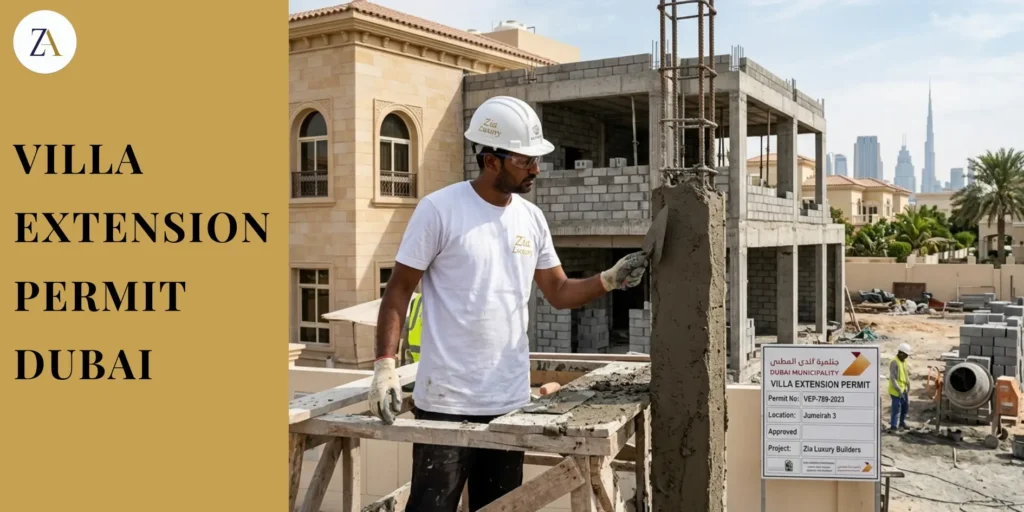
When it comes to adding a new bedroom, another kitchen, or a home office in your garden, if you’re a Dubai villa owner, you can’t miss one thing—the villa extension permit. Not doing so could risk a fine and even a stop-work order, forced demolition, or even a delayed sale in the future if the property is in a state of disrepair.
The good news? If you know what approval route applies to your community, it isn’t as daunting. This guide explains what you’ll need, to whom you’ll submit, and the time frame to ensure you plan your villa extension with confidence.
Do You Need a Permit for a Villa Extension in Dubai?
Yes. Adding a room, an enclosed terrace, a second floor, or even a large pergola will increase your Built-Up Area (BUA) of your villa and must be approved formally before work begins.
This applies regardless of size. A small extension and a full second-story addition go through the same basic principle: no permit, no build. The only difference is how much documentation and structural review each one needs.
Skipping approval can lead to:
- Fines starting from AED 10,000
- Stop-work orders mid-project
- Forced removal of the unauthorized structure
- Complications during resale, since unapproved changes get flagged at title transfer
Types of Villa Extensions That Require Permits
Almost every structural addition to your villa needs a permit, including:
- Single-storey extensions – expanding the kitchen, dining, or living area on the ground floor
- Double-storey extensions – adding a second level for extra bedrooms or a home office
- Side and rear extensions – extending the footprint to create larger open-plan spaces or connect indoor and outdoor living
- Over-roof extensions – rooftop rooms, terraces, or garden structures
- Garden rooms, majlis additions, and pool cabanas – increasingly popular in Dubai’s luxury villa communities, but still count as BUA increases
Even removing an internal load-bearing wall without adding new floor area can trigger a structural engineer’s sign-off and municipal approval.
The 3 Villa Extension Permit Routes in Dubai
This is the part most guides skip—and it’s the most important one. Your permit process depends entirely on which type of community your villa sits in.
- Emaar Communities (Arabian Ranches, Dubai Hills Estate, The Springs, The Meadows, Emirates Hills)
You’ll apply through the Emaar Community Portal under the Home Modification process. A Design Review Committee reviews any structural or external work, and a Gross Floor Area (GFA) fee applies to any increase in built-up area—this is often the highest single cost in the whole project. Conditional approval, once issued, is typically valid for six months.
- Nakheel Communities (Palm Jumeirah, Jumeirah Islands, Jumeirah Park, Al Furjan villas, JVT)
Here, the process runs through Nakheel Community Management for the NOC, followed by a Trakhees CED structural permit. Palm Jumeirah applications specifically go through Trakhees review rather than the Dubai Municipality directly. A refundable security deposit is usually part of this route.
- Independent Mainland Villas (Jumeirah, Umm Suqeim, Al Wasl, Al Safa, parts of Mirdif—properties outside a masterplan community)
No developer NOC layer here. You apply directly through Dubai Municipality’s Building Permit System (BPS) portal, submitting your structural drawings and site survey straight to DM.
A quick note on DAMAC villas: applications go through DAMAC Facilities Management before any municipal submission.
Documents Required for a Villa Extension Permit
Regardless of which route applies to you, most authorities ask for:
- Architectural drawings showing existing and proposed layouts
- Structural drawings and calculations stamped by a DM-registered structural engineer
- GFA calculation showing the newly built-up area in square feet
- Site survey confirming boundary and setback compliance
- No Objection Certificate (NOC) from your master developer, where applicable
- DEWA clearance for any change in electrical or water load
- Contractor and consultant trade licenses registered in Dubai
Missing even one of these is the most common reason applications get delayed with a Request for Information (RFI).
Villa Extension Permit Fees & Costs
Costs vary by community, but here’s a realistic picture:
- Emaar communities: an application review fee, plus a per-square-foot GFA fee that scales with the added floor area—this is usually the biggest cost driver
- Nakheel communities: developer NOC fees plus Trakhees CED permit charges
- Independent DM plots: a straightforward Dubai Municipality building permit fee based on BUA, with no developer layer
- On all routes: the structural consultant fees for drawings, the DEWA load increase fees, and a security deposit (refundable in some communities)
It’s advisable to factor in a contingency over these costs because the design may need to be adjusted during the review, which would require additional consultant hours.
How Long Does Permit Approval Take?
On average, homeowners should plan for:
- Initial document review: 3–5 working days
- Design Review Committee / structural review: 1–2 weeks for standard scopes, longer for major structural work
- Conditional to final approval: a few additional weeks once GFA fees or deposits are settled
- Construction phase (after approval): 3–6 months, depending on the size of the extension
Incomplete documentation is the single biggest cause of delay—which is exactly why working with an experienced consultant from day one matters.
Common Reasons Villa Extension Permits Get Rejected
Most rejections aren’t about the design—they’re about the paperwork and planning around it:
- Structural drawings not stamped by a DM-registered engineer
- Extension footprint breaching setback or boundary distance rules
- Facade materials that don’t match the community’s architectural guidelines
- Missing or outdated NOC from the master developer
- Underestimating GFA fees is causing budget-related project delays
Catching these issues before submission—not after an RFI—is what separates a smooth approval from a stalled one.
Why Work With Zia Luxury for Your Villa Extension Permit
Villa extension permits in Dubai aren’t a one-size-fits-all process, and getting the wrong route wrong can cost you months. Zia Luxury has managed 500+ projects across Dubai since 2019, including work within Emaar, Nakheel, and DAMAC communities—so we know exactly which authority your villa needs to go through.
Here’s what that means for you:
- DED registered and Dubai Municipality licensed, with all work compliant with Municipality, DEWA, and UAE fire safety regulations
- Fixed, itemized pricing with zero hidden costs once your quote is approved
- Full 3D visualization of your extension before a single wall is touched
- One dedicated project manager handling design, approvals, and execution end-to-end
- 12 months of defects liability after handover, with snags fixed at zero cost
We handle the entire permit journey—documentation, NOC coordination, structural drawings, and authority submission—so your extension moves from idea to approval without the back-and-forth.
Frequently Asked Question
Yes, any change that increases your villa's built-up area needs approval. This applies whether you're adding a single room or a full second floor.
Costs vary by community — Emaar's GFA fee is often the largest expense, while independent DM plots pay a simpler building permit fee. Always budget for consultant and NOC fees too.
Standard extensions typically take a few weeks for document and design review before conditional approval. Larger structural changes can take longer.
No, starting work before approval risks fines, stop-work orders, and forced removal of the structure. Always wait for written approval before construction begins.
Most rejections stem from missing documents or non-compliant designs and can be resubmitted after corrections. Working with an experienced consultant reduces the chance of rejection significantly.
Conclusion
A villa extension can transform how your family lives in your Dubai home—but only if the permit process is handled correctly from the start. Knowing which of the three approval routes applies to your community, and having your documentation ready, is what keeps your project on schedule and out of legal trouble.
Zia Luxury manages the entire permit and build journey, from the first NOC application to final handover, so you can focus on the space you’re creating—not the paperwork behind it.