

Villa Renovation Dubai Guide: Costs, Timeline & Permits
- July 7, 2026
- Zia Luxury
- 5:07 am
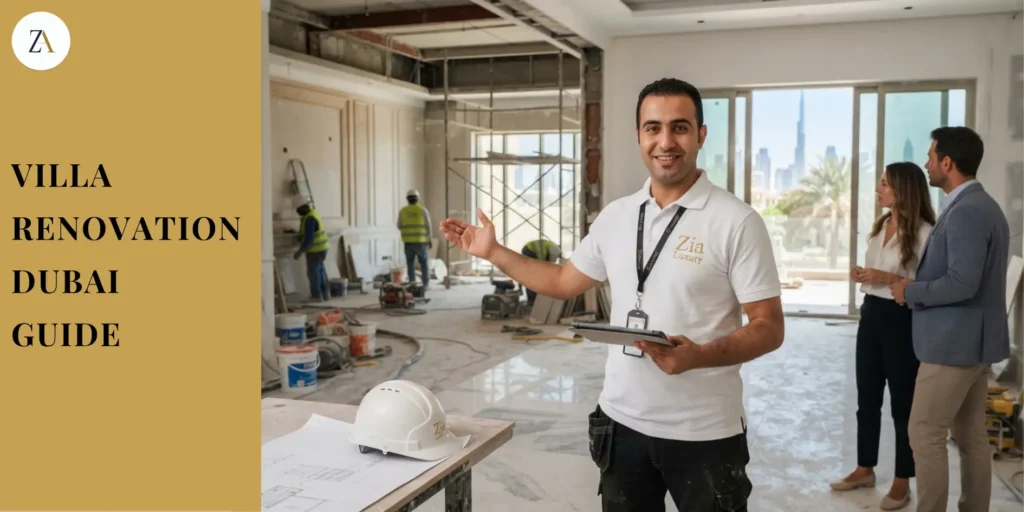
As a villa owner in Dubai, you may be facing similar challenges and debates with others in your vicinity about villa renovations for 2026, where the possibilities are endless. With the rising value of their homes, shifting family requirements, and finally design trends that have outgrown that “all-white minimalist” aesthetic of the past few years, more residents in Arabian Ranches, Emirates Hills, Jumeirah, and the Springs are opting to remodel their homes over relocating.
But villa renovation in Dubai is not a one-size-fits-all process, which consists of only choosing new tiles and hiring a contractor. The time frame is from a few weeks to a couple of months (depending on scale), cost planning, community approvals, etc. Whether you are looking to renovate your home yourself or hire a professional, this guide will take you through everything you should expect: real numbers, real permits, and a real process.
How Much Does Villa Renovation Cost in Dubai?
The cost of villa renovation in Dubai ranges widely, as “renovated” can be interpreted to mean anything from a new coat of paint to a complete change of the villa’s structure. On average, in 2026, homeowners expect to spend:
- Chemical restorations (like painting, flooring, fix-ups, etc.) AED 150–300 per sq. ft.
- Mid-range renovation (kitchen and bathroom overhaul, partial layout changes, new electrical/plumbing points): AED 300 – 500 per sq. ft.
- Complete layout changes, extensions, full MEP rework and luxury finishes: AED 500–900+ per sq. ft.
In a typical case of a 4-bedroom villa (4,000 sq. ft. – 5,000 sq. ft. in Dubai), this means anything from AED 600,000 for a cosmetic refresh to AED 2.5 million and over for a full luxury refurbishment.
A few factors that push costs up or down:
- Age of the villa — older properties (especially pre-2010 builds) often need MEP and structural work before any cosmetic changes are even possible
- Material selection — imported marble, custom joinery, and smart home integration add significantly to cost
- Community rules — some gated communities require specific finishes or facade guidelines, which can affect material sourcing
- Scope creep — unclear planning at the start is the single biggest reason renovation budgets go over
The smartest first step is getting a fixed quote based on a proper site survey and 3D design, rather than a rough verbal estimate. This is where most cost overruns actually start.
Villa Renovation Timeline: How Long Does It Actually Take?
Timeline is the question we get asked most often, and the honest answer is: it depends entirely on scope. Here’s a realistic breakdown:
- Cosmetic renovation: 3–5 weeks
- Kitchen and bathroom renovation: 6–8 weeks
- Mid-range whole-villa renovation: 3–4 months
- Full structural renovation with extensions: 5–8 months
These timelines assume permits are approved on schedule and there are no major structural surprises once walls or flooring are opened up—which, in older villas, does happen more often than people expect. Adding a buffer of 2–3 weeks to any timeline estimate is realistic planning, not pessimism.
The Legal Side: Permits & NOCs You Actually Need
This is the part most villa renovation guides skip entirely—and it’s the part that causes the most delays when homeowners aren’t prepared for it.
Depending on your villa’s location and renovation scope, you may need approvals from:
- Dubai Municipality (DM): For any structural changes, extensions, or modifications to the external structure.
- Approvals are made through Trakhees: if your villa is in a community that falls under Trakhees (e.g., Jumeirah Islands or some places in Palm Jumeirah), then it is made through them rather than DM.
- Developer/Community NOC: If a community such as Emaar, Nakheel, and DAMAC needs a No Objection Certificate for any facade changes or extensions, this will be required before any renovation works.
- DEWA approval — needed for any changes to electrical load, meter upgrades, or major plumbing rerouting
Cosmetic work (paint, flooring, and fixed furniture) generally doesn’t require permits. But structural changes, extensions, and anything altering the building’s footprint absolutely do. Starting work without the right approvals can lead to fines, forced reversal of completed work, or issues when you eventually sell the property.
A licensed fitout company handles this NOC and permit process on your behalf as part of the renovation package, which is one of the most valuable (and least visible) parts of hiring the right partner.
The Renovation Process: Step by Step
Here’s what a well-managed villa renovation actually looks like from start to finish:
Initial consultation and site survey
A physical assessment of your villa to understand structural condition, layout potential, and any existing issues that need addressing before design begins.
3D design and material selection
Before any work starts, you should be able to see your renovated villa in 3D — layout, finishes, lighting, and furniture placement — so there are no surprises later.
Fixed quotation
A transparent, itemized quote based on the finalized design, not a rough estimate that changes halfway through the project.
Permit and NOC processing
Your contractor submits and manages the required approvals from DM, Trakhees, or the community developer, depending on your villa’s location.
Permit and NOC processing
Your contractor submits and manages the required approvals from DM, Trakhees, or the community developer, depending on your villa’s location.
Execution
Structural work, MEP (mechanical, electrical, plumbing), then finishes — flooring, painting, joinery, and fixtures — in that order.
Quality inspection and handover
A final walkthrough to check every detail against the agreed scope before the keys are officially handed back to you.
Aftercare
Guarantee of defect repair for a period of 12 months or longer (ideally) with no additional charges for defects occurring after handover.
Most Popular Villa Renovation Areas in 2026
Some rooms and amenities are in greatest demand for remodeling this year:
- Kitchens — open plan, built-in smart tech and bigger islands are the most popular requests
- Bathrooms – separate tubs, rain showers, and stone colours (a little warmer than white) replacing the all-white appearance.
- Outdoor and pool areas — outdoor kitchens, shaded majlis seating, and pool resurfacing are especially popular given Dubai’s outdoor lifestyle
- Smart home integration — lighting, climate control, and security systems controlled from a single app, now a standard request rather than a luxury add-on
Common Mistakes to Avoid
A poorly planned renovation almost always traces back to one of these:
- Starting without a fixed quote — verbal estimates almost always change once work begins
- Skipping permits — even “small” structural changes can require DM or community approval
- Choosing based on price alone — the cheapest quote is rarely the cheapest project by the time delays and rework are factored in
- No aftercare clause — always confirm what happens if an issue appears after handover
- Unclear scope documentation — get everything in writing, including material brands and finish levels, before work starts
Why Choose a Licensed Fitout Partner in Dubai
Villa renovation involves real money, real permits, and real disruption to your home life — it’s not the place to take chances on an unlicensed or unregistered contractor. Working with a DED-licensed fitout company means:
- Your renovation complies with Dubai Municipality and community regulations from day one
- You get a fixed, transparent quote instead of an estimate that grows mid-project
- 3D visualization means you approve the design before a single wall is touched
- A structured aftercare period protects you after handover, not just during construction
This is exactly how we approach every villa renovation project at Zia Luxury — licensed, permit-managed, fixed-quote, and backed by a 12-month aftercare period so you’re covered well after the final walkthrough.
Frequently Asked Question
The cost of cosmetic work is between AED 150 and 300 per sq.ft. while full structural renovation costs are AED 900 and above. There is a 3D design that will provide you an accurate and fixed number after a site survey.
If the cosmetic changes are simple, there is no need for approval from Dubai Municipality, Trakhees, or your community developer, if it is structural, extensions or facades.
The standard whole-house renovation will take 3-4 months, with a structural renovation and extension taking between 5-8 months.
It depends on scope—cosmetic or single-room renovations can be done fairly easily, but if you need a full structural renovation, it is much more comfortable to temporarily move out.
Failing to begin a project with a definite quote or the proper permits invariably results in over budget and project delays.
Conclusion
Villa Dubai renovation can be a huge investment, but it can prove to be one of the most successful strategies for improving your lifestyle and that of your home — if done correctly from the start. The right partner will provide you with transparency at the outset, handle the permit process for you, and be there after the handover to support you.
When you’re ready to take the next step to a fixed quote and a 3D design you can see, then our team at Zia Luxury is here to help you through each step of the way.