 Skip to main content


What Defines Traditional Interior Design Style?
- September 11, 2026
- Zia Luxury
- 4:48 am
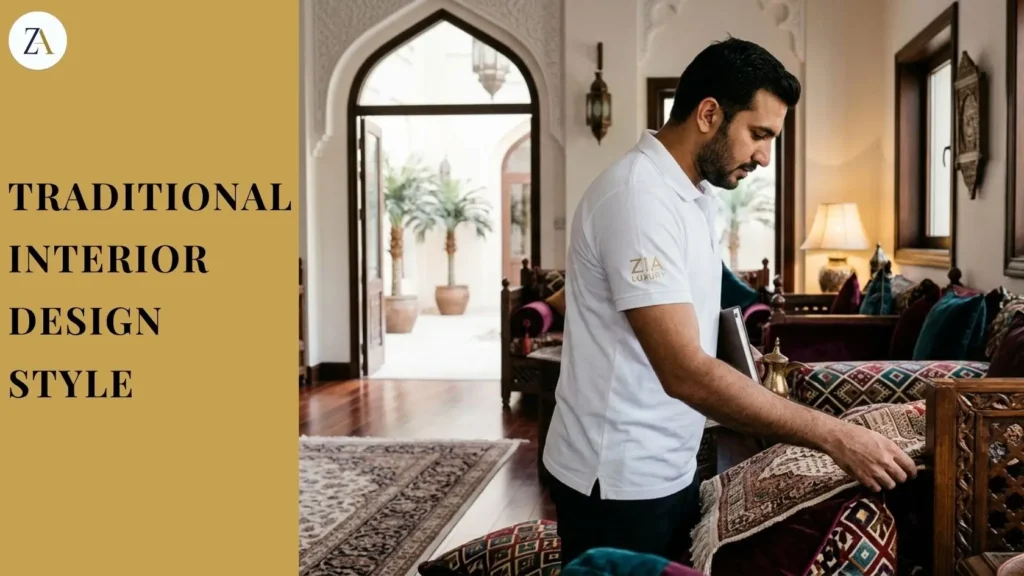
This is usually the first fork in the road for any Dubai homeowner starting a renovation: traditional or modern? It’s a bigger decision than picking a colour scheme — it shapes furniture proportions, lighting design and even how rooms are laid out relative to each other. Neither is objectively better; the right answer depends on how you actually live in the home, not just how it photographs.
Here’s a practical, side-by-side look at the two, along with where most Dubai homes are landing in 2026.
Traditional Interior Design: What It Actually Means
Traditional interior design in a Dubai home typically borrows from European classical detailing rather than local heritage style — think symmetry, ornate furniture legs, rich upholstery fabrics, and warm wood tones. Rooms are usually more segmented, with distinct purposes: a formal living room separate from a family lounge, a dedicated dining room rather than an open dining nook.
- Furniture: carved wood frames, tufted upholstery, matched pairs (armchairs, side tables) for symmetry
- Colour: warm neutrals, burgundy, forest green, gold accents
- Lighting: chandeliers and wall sconces as focal points rather than recessed downlights alone
Modern Interior Design: What It Actually Means
Modern interior design strips detail back to function and proportion. Furniture has cleaner lines, materials are left closer to their natural finish, and colour is used sparingly — usually one accent tone against a neutral base rather than a full palette.
- Furniture: clean-lined, often low-profile, mixed materials (wood, metal, leather)
- Colour: neutral base — white, grey, taupe — with a single bold accent
- Lighting: recessed and linear fixtures, statement pendant only over key areas like the dining table
Traditional vs Modern: Side-by-Side
Aspect | Traditional | Modern |
|---|---|---|
Room layout | Segmented, purpose-specific rooms | Open-plan, multi-purpose zones |
Furniture | Ornate, matched sets | Clean lines, mixed materials |
Colour use | Rich, layered palette | Restrained, one accent tone |
Maintenance | Higher — detailed surfaces, upholstery | Lower — simpler surfaces, fewer textures |
Resale appeal (2026) | Strong in classic-style villas | Strong in newer developments |
Which Style Actually Fits How You Live?
If you host formal family gatherings regularly, or your family expects a clearly defined majlis and dining room, traditional layouts tend to work better in practice — not just aesthetically. If your household is smaller, or you entertain casually rather than formally, an open modern layout usually gets used more, because there’s no “good room” that sits empty most of the year.
Blending Both: The Transitional Approach
Most Dubai homes we work on aren’t purely one or the other. A transitional approach keeps a modern, open-plan structural layout but introduces traditional furniture pieces, richer colour in one or two rooms, or classic detailing on the staircase and entrance. It’s a lower-risk way to get warmth without committing to a fully traditional build.
What's Actually Trending in Dubai Right Now
Style preferences shift faster than most owners expect. Our roundup of current interior design trends in Dubai tracks what’s actually being requested this year, rather than what was popular two or three years ago.
Finding the Right Design Partner for Either Style
Not every design and fit-out company is equally strong in both directions — some studios lean heavily modern and struggle with traditional detailing, and vice versa. Our guide on how to choose an interior design company in Dubai covers the questions worth asking before you sign a contract.
Material Choices for Each Style
Traditional and modern styles often call for different base materials even within the same villa. Our villa interior materials guide breaks down flooring, wall finishes and fixtures suited to each direction, room by room.
Frequently Asked Question
No — it's still common in classic-style villas in Emirates Hills and Arabian Ranches, particularly in formal living and dining rooms. What has changed is that fewer homes apply it throughout the entire property.
Generally yes, because it uses fewer decorative elements and simpler surface treatments. Traditional design's cost comes mainly from bespoke joinery, upholstery and detailed plasterwork.
Partially. Furniture, lighting and colour changes can shift the feel significantly without touching the layout. A full shift usually requires reworking flooring and removing partition walls, which is a bigger renovation scope.
It depends on the buyer pool for the community. In newer developments, modern interiors tend to show better. In established villa communities with classic architecture, traditional interiors often feel more coherent with the property.
Conclusion
A short site visit usually settles the traditional-vs-modern question faster than weeks of scrolling inspiration boards. Zia Luxury Interior Fitout designs and builds in both directions across Dubai. Book a free consultation and we’ll talk through what actually suits your household.
